(2 minute read)
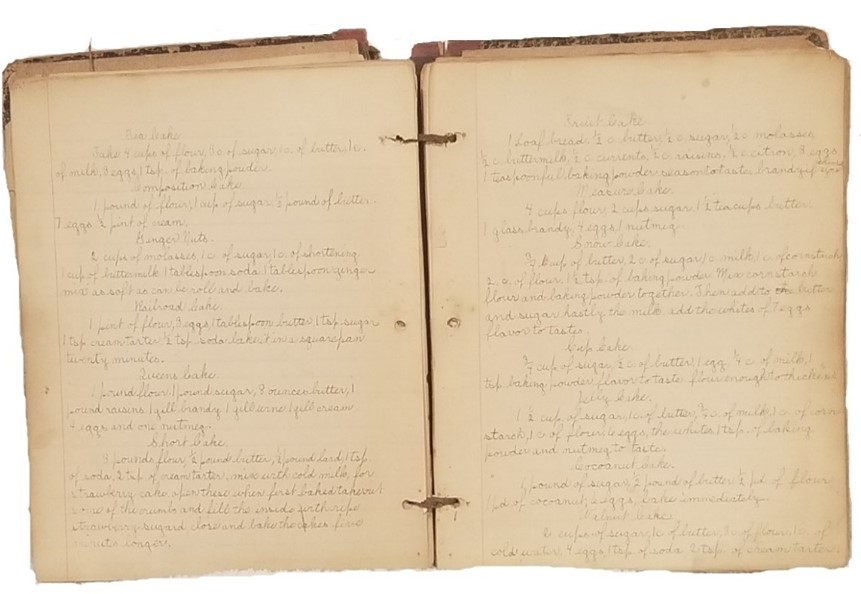
One says add 25 cents worth of meat. Another says add butter, one-half the size of an egg. I’m talking about recipes I found in my Grandma’s notebooks from 100 plus years ago. I wonder how much meat 25 cents would buy back when she wrote the recipe. Certainly more than just the spoonful it would buy today. And how big is one-half of an egg anyway? Or for that matter, how big was a whole egg back then? Aren’t eggs bigger now than they were 100 years ago?
I have three of her recipe books. Her handwriting is absolutely beautiful. Each letter is written perfectly the same every time, and the spaces between words are precise and even. At first glance the pages look like they were created using a cursive font on a computer.
The largest recipe book is a composition notebook from her school days. It mostly has recipes, plus general rules for cooking and good table manners. My grandmother was born in 1888 in Davenport, Iowa and her formal education ended with her 8th grade graduation, so I suppose the composition notebook is from 1900 or thereabouts.
The second recipe book is pocket-sized and filled with newspaper and magazine clippings. But are these recipes she actually made? Or are they recipes that just caught her eye, but never got around to making? My mom also collected recipes, but never made most of them. In later years, she typed them on her computer. I remember when I told her about having a lemon tree in the back yard and a bumper crop of zucchini. Mom sent me sent me printouts of dozens of recipes for lemons and for zucchini, most of which she never made, but had painstakingly typed and stored in her database.
The third notebook is small and has my grandmother’s handwritten recipes, mostly desserts. I guess I must have gotten my sweet tooth from her. Most recipes just list the ingredients. There are no instructions. Nothing about mixing the dry ingredients together, then mixing the wet ingredients together, and then combining the dry and the wet ingredients, and then baking the batter at a specific temperature for an estimated number of minutes.
At first I thought the recipes were missing instructions because she was writing down the recipes just for herself and so there was no point in writing more since she knew what to do next. But I was wrong. When I looked at the recipes in her school composition book, they, too, were missing instructions when it came to baking.
I did a little research and found that around 1900 stoves used wood, coal, or gas. Ovens didn’t have thermostats until after WWI, so recipes at the turn of the century didn’t mention what temperature to use or how long to bake something. No one knew exactly what temperature their oven was, but they had an understanding of how much fuel was needed to get the oven just right for baking (not too hot, not too cold) and how much time was needed for each recipe.
I heard that my grandmother was a good cook, but there’s no one left who can tell me what her best dishes were or what her recipes should taste like. I’d like to try my hand at making some of her recipes, starting with that little brown notebook, the one with the recipes she carefully copied by hand.

 Sue T's Blog