Activities of Daily Living

(Estimated reading time: 3 minutes)

Take a moment to picture all the routine activities that are part of daily life, starting with getting out of bed to start the day. Things like: using the bathroom, maybe taking care of pets, getting breakfast, making the bed, brushing teeth, getting dressed, and so on…

And as the day goes on, there are other everyday, but necessary tasks that need to be done if you are an independent adult. You can probably think of more, but here are a few things that come to mind. Things like: driving, shopping, cooking, cleaning, laundry, arranging for repairs, managing medications, plus all the activities that are part of managing a household.

All of these mundane, but necessary tasks are what healthcare professionals call the activities of daily living or ADLs.

Healthcare professionals often use the activities of daily living to measure the ability to function or to live alone safely. A decline in personal hygiene or mobility may be signs of a health issue that needs to be addressed.

Recognizing someone’s limitations is the first step in developing a plan to safely age in place at home. Holidays and other family gatherings offer a good opportunity for family and friends to compare notes on how a loved one is doing and to discuss if it’s time to plan for extra help around the house or possible time to think about assisted living.

Assessing someone’s functional status can be tricky. Sometimes people deny or even try to hide or downplay that they need any help. More than once, I’ve heard a someone tell me that yes, they can walk without any help, and then later admit that by walking, they meant that they were able to manage a few steps from their wheelchair to their bed and vice versa. Taking a step or two isn’t the same as being able to walk or use stairs with no fear of falling.

Activities of Daily Living

Most of the activities of daily living have to do with routine personal care. Here’s a list:

  • Personal hygiene (bathing, grooming, brushing teeth, trimming nails, hair care)
  • Dressing (the ability to get dressed without assistance, to select and wear appropriate clothes for the weather or for an occasion)
  • Walking and managing stairs
  • Transferring (generally moving from one place to another without assistance, getting in and out of bed, chairs, cars; stepping over a bathtub to get into a shower)
  • Eating without assistance (does not include cooking, chewing, or swallowing)
  • Toileting (continence management, getting to the toilet, cleaning oneself, getting back up off the toilet); mental and physical ability to properly use the bathroom)

A pattern

There’s a pattern you can look for when it comes to the activities of daily living starting with hygiene, mobility, and then with eating.

As someone ages and their health starts to decline, one of the first things to look for are changes in their personal hygiene. Are they forgetting or refusing to shower or wash their hair? Are they wearing pajamas all day or wearing the same clothes for several days at a time? Are fingernails and toenails clean and trimmed?

Often after a decline in hygiene comes problems with mobility: walking, using stairs, getting into and out of a chair or bed, and eventually using the shower without someone on standby, help getting to the toilet.

Late in the aging process comes difficulty using knives, forks, and spoons when eating, or chewing or swallowing certain foods.

Instrumental Activities of Daily Living

The experts lump activities that aren’t related to self-care in a category called the instrumental activities of daily living (or IADLs). These are the mundane, but necessary tasks for being a responsible adult and for living independently. You can think of the IADLs as adulting skills. They include:

  • Driving, using public transportation, or arranging for transportation
  • Preparing meals (shopping, storing groceries, cooking)
  • Managing a household (cleaning, tidying up, removing trash and clutter, doing laundry, folding clothes, handling home repairs, making a home hospitable, decorating for holidays)
  • Managing medications (getting prescriptions filled, keeping medications up to date, taking medications on time and in the right dosages)
  • Managing money (managing bank balances and checkbooks, paying bills on time)
  • Managing time (maintaining a schedule, tracking appointments on a calendar)
  • Caring for others (children, pets)
  • Having companionship and mental support (family, friends, clubs, groups, religion)
  • Communicating with others (conversations without struggling for words; mail, phone calls, text, email)
  • Responding appropriately to emergencies, safety concerns

Checklists for the activities of daily living

A checklist may help you prepare for a discussion with family, caregivers, or medical professionals. There are many checklists available online. They are usually in the form of a table that lists self-care activities plus column headings for independent, needs someone to stand by, and needs help. I have one that I’ve created myself that I will post in the future.

Use Google Alerts to keep informed

(Estimated reading time: 2 minutes)

Anyone can use Google Alerts to track anything–hometown news, hobbies, genealogy, a favorite celebrity, and so on.

Businesses use Google Alerts to track the latest posts on:

  • The company
  • Products or services
  • Executive and key personnel
  • Competitors and
  • Industry-related topics

If you are part of the sandwich generation, Google Alerts can help you find resources that can help you juggle caring for aging parents while raising a family and holding a job. Google Alerts can help you find day camps for kids (or seniors), support groups, transportation to medical appointments, or local agencies that offer free or low-cost services for seniors.

If you are decluttering and downsizing, Google Alerts can help you sell or donate books, china dishes, furniture, and other household items.

The Google Alerts that come to my email every day list the latest internet posts on just the topics that I’m interested in. I skim the title of each post, check out the source (newspaper, newsletter, blog, website, and so on), and skim the brief description of the post. Then I click just the posts that I want to view in more detail.

How to create a Google Alert

  1. Go to www.google.com/alerts.
  2. Sign in using your Google email (gmail) account.
  3. Type the word or phrase you want to search.
    Use quotation marks to look up a specific phrase. For example, if you enter German chocolate cake without quotation marks, the results will show every web post that has the word German, chocolate, or cake. If you put the phrase in quotation marks, then the results will show only the posts that have the phrase, German chocolate cake.
  4. Scroll down and check out the preview of the results based on the search terms you just typed. If you aren’t happy with the preview, change the search terms.
  5. Use Show Options to select how often you want to get email with the alerts, the sources you want to Google to search, and so on.
  6. Enter the email address that Google should send the alerts to.

Some tips for better results

If you aren’t getting the results you want, try tweaking the search terms.

  • Add some common misspellings of your search terms to see if Google picks up more or different results.
  • Use a minus sign to add or subtract a subcategory from the search. This is a little tricky.
    • A space before and after the minus sign tells Google to limit that search to a specific subcategory.
    • No space after the minus sign tells Google to subtract a specific subcategory. This is a good way to exclude people, places, or things that have a similar name, like seeing results just for Concord, California and not for the other Concords in the world.
    • Let’s look at a couple of examples.
Alzheimer’s caregivers – Concord, CA Finds posts on Alzheimer’s caregivers in Concord, CA.
(Note space before and after minus.)
Alzheimer’s caregivers -Concord, CA Shows information on Alzheimer caregivers, except for Concord, California.(No space after the minus.)

Doing the Bix 7

(Estimated reading time: 3 minutes)

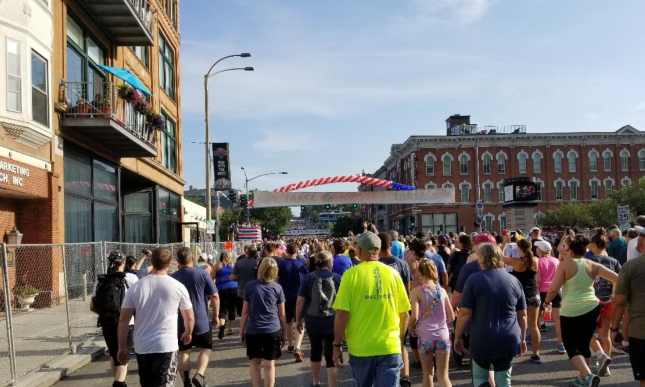
This is what it looks like when 20,000 people make their way up Brady Street

In July I joined 20,000 plus runners and walkers for the annual Bix-7 race in the Quad Cities. I live in California now, but the Quad Cities is where I grew up and where most of my family still lives.

The Quad Cities is a group of communities on the Mississippi River with Iowa on one side and Illinois on the other. There are five main cities (yes, five, not four) in the Quad Cities: Davenport, Bettendorf, Rock Island, Moline, and East Moline.

The Bix 7 race kicks off the annual Bix jazz festival that celebrates the music of Bix Biederbecke. Bix was a jazz legend from the 1920s from Davenport, Iowa who lived hard and died young.

Bix Biederbecke, Jazz legend

This was the fourth time I’ve walked the Bix. The race course is seven miles with the first mile being uphill, but there’s also a two-mile option called the Quick Bix, which is what I did this year, where you go up the Brady Street hill, turn right near the Palmer College of Chiropractic, walk one block, and then head right back down the steep hill again to the afterparty.  

Just being in the race this year was a personal victory for me. I had surgery last fall on my Achilles tendon. Thinking about doing the Bix seemed impossible back in January when I was still using a walker, but just thinking about being in the race and catching up with family helped keep me motivated as my left leg relearned how to walk and how to use the stairs. I kept telling myself that my body wants to heal and I kept asking myself what could I do to help it heal.

In January I worked out how many steps on my fitness tracker I would need to cover seven miles. The plan was to gradually increase my step count each month so I would be able to handle seven miles in one go by July. I got an exercise bike and started walking around the neighborhood. I joined the local Y so I could do my physical therapy in the pool. I tried a yoga class but quit when I injured my knee trying to keep up with the class. I got back into Tai Chi, started Pilates, and used the Coach Potato to 5K app on my phone to keep me inspired.

About a month before the race, I realized I was way behind on my step count goals so I started pushing myself to walk more. About a week before the race, I woke up one morning barely able to move. I had just a few days before my flight and I wasn’t sure if I could walk from gate to gate at the airport, let alone walk seven miles or even two in a race. I massaged my ankle with a salve with CDB oil and put my feet up when I could. Luckily by race day, I was ready for the two-mile course.

The actual race wasn’t easy for me. It was hot and humid and there was still a little swelling in my left ankle. The first mile was uphill all the way and for a moment near the very top I wasn’t sure if I could make it. So I concentrated on the positives, hanging with my sister, amazed at the site of thousands of people ahead of me going up the hill, checking out the costumes some of the racers wore. We waved back at the crowd gathered to watch the race and laughed at sign in front of the fraternity that invited racers to stop by for a beer. We watched an older man doing the race with crutches and his friend who had a wheelchair on standby and wondered how it was that he was still ahead of us. Someone blasted 70’s disco music and I sang along with the crowd. Someone played Major Tom on a guitar and we sang along with that, too.

We wondered how the man with crutches was still ahead of us

I feel like I should wrap this post up with a moral of some kind. I set a goal of walking seven miles in a race. I worked hard, but in the end, I couldn’t walk seven miles and barely finished two. But when I look at the bigger picture, all the training I did was about more than just walking the Bix. It was really about me reconnecting to family and getting healthy again. The body really does want to heal.

Counting the people you count on

(Estimated reading time: 1 minute)

Ever feel overwhelmed by the people in your life? Here’s some math that may help explain why. You see, it’s not just how many people are in your life, it’s also about how they get along with each other.

To calculate the number of possible relationships, start by counting the number of people in your inner circle. Include anyone you trust to have your best interests at heart. Take this number and multiply it by the same number minus one. Then divide the end result by two. The answer is the number of potential relationships in your circle, not the actual number of relationships.

Some people in your inner circle probably genuinely love and care for each other, but chances are there are a few who don’t know each other well or just don’t get along.

Here’s a more conventional way of writing this formula:

R = [N x (N-1)/2]

Where R equals the number of potential relationships and N equals the total number of people.

So for two parents with two kids, there are six potential relationships within a family of four ((4 x 3) / 2 = 6).

Add a third kid, and there are 10 potential relationships in that family ((5 x 4) / 2 = 10).

If you are married, have three kids and two sets of aging parents, that comes to 36 potential relationships just within the family.

And if you then add a couple of siblings, plus a couple of aunts to the family of five with two sets of aging parents, that comes to 78 potential relationships to navigate just within the family. Who is in your inner circle of family and friends? How many potential relationships are there in your circle? Here’s a tougher question. How many of those people can you count on to take care of you when it’s your turn to need a little help?

Use family gatherings to compare notes, plan ahead

(Estimated reading time: 30 seconds)

Sometimes friends and family are the last to realize that a senior needs help. Seniors may try to hide that they are struggling with everyday tasks, like managing stairs, bathing, vacuuming, or driving. They know that they can’t do the things they used to do, but still want to keep their independence and don’t want to bother friends or family.

Afraid of falling when stepping into the tub to take a shower? Well, a sponge bath at the sink will work. Too many stairs to the laundry room? Laundry basket getting too heavy? Maybe I can wash my clothes less often. Cooking getting too much for just one person? Well, a can of soup or just some crackers and cheese will do.

Holidays and other family gatherings offer a good opportunity for family to compare notes on any changes they’ve observed lately and come up with a plan for helping a senior stay safe in their home.

Welcome

My name is Sue Kohl Tamaoki. Until recently I was a senior referral agent, helping older adults find independent living, assisted living, or memory care. Like most senior referral agents, my services were free to the family. I made my living by getting a referral fee from the senior community after a client moved in.

I recently had to close my senior referral business and rethink my career options after having surgery on my Achilles Tendon. The long recovery made it impossible to meet with clients or tour communities for several months. This blog allows me to share my thoughts and resources with you for navigating the aging process. It is based on what I learned from working with families, the senior communities, and other senior professionals. I also reserve the right to write about any other topic that interests me, since this is my blog, after all.